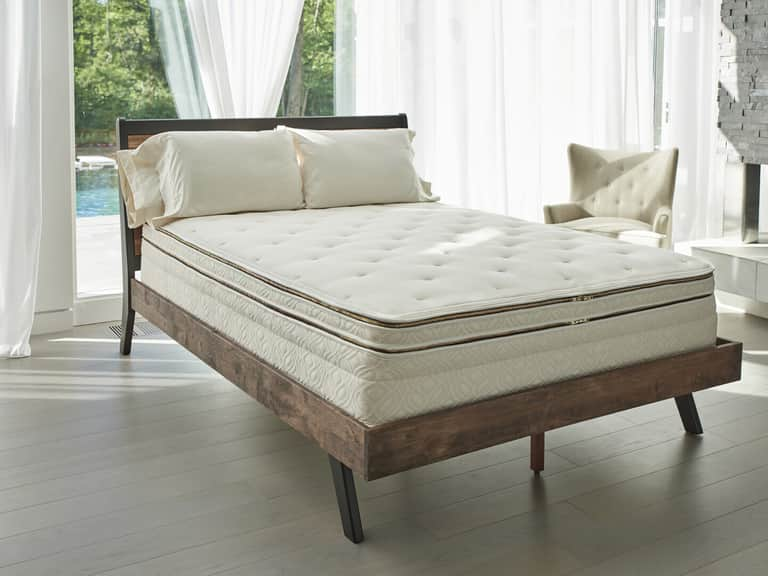
Mattress construction, explained
Dunlop Latex Construction: Understanding Density, Feel, and Support
“Dunlop latex” tells you something about how a latex foam layer is made—but it doesn’t, on its own, tell you whether a mattress will feel plush, firm, buoyant, or supportive. To understand the sleep surface, look beyond the label to the layer’s firmness, density, thickness, and position within the mattress.
Published November 11, 2026
Shopping for a natural latex mattress can feel like learning a new language. Product descriptions may mention Dunlop, organic latex, density, firmness, ILD, comfort layers, and support cores—sometimes as though each term delivers a complete verdict. In reality, every detail describes only part of the construction.
Dunlop is a manufacturing method used to make latex foam. Density describes how much material is present in a given volume. Firmness measurements aim to describe resistance to compression. And the way a mattress feels in a bedroom depends on how those features work together, including the surrounding materials and the sleeper’s body and sleeping position.
That distinction matters because two mattresses can both use Dunlop latex and feel noticeably different. One may have a firm, substantial feel; another may offer a softer surface over a supportive base. The name of the process is a starting point, not a shortcut to predicting comfort.
What does “Dunlop latex” mean?
Dunlop latex is latex foam produced by placing a liquid latex mixture into a mold, then heating it so the material sets into a resilient foam. After curing, the foam is washed and dried. The process has been used for decades and can be applied to natural latex, synthetic latex, or blends, depending on the formulation.
The word “Dunlop” identifies the process, not necessarily the ingredients. A mattress described as Dunlop latex is not automatically made entirely from natural rubber, and it is not automatically certified organic. For those distinctions, check the product’s material specifications and any relevant certification details rather than relying on the construction name alone.
Within a finished mattress, Dunlop latex can serve as a comfort layer, a transition layer, a thicker support core, or one part of a layered design. The same basic foam-making method can therefore appear in mattresses with very different overall profiles.
Density and firmness are related—but not interchangeable
Density and firmness are often discussed together, which can make them sound like two ways to express the same thing. They are not. Density is the mass of a material in a defined volume. Firmness is a measure of how much force is needed to compress it under specified test conditions.
A denser foam contains more material per unit of volume, but that fact alone does not tell you exactly how firm it will feel. Formulation, manufacturing details, and the construction around the foam all play a role. A density figure can help characterize the material, but it should not be treated as a simple firmness rating.
Firmness may be reported using an indentation force measurement, often abbreviated as ILD or IFD. In general terms, this describes the force required to compress a sample by a specified amount under a standardized test. It can help compare foam samples, especially when the measurements use the same testing method. Still, it is not a perfect translation into a universal consumer scale such as “soft” or “firm.”
When reviewing specifications, look for clear definitions: What units are being used? Is the number a density, an ILD/IFD value, or a manufacturer’s firmness label? Are measurements available for each layer, or just the mattress as a whole? A well-described construction makes comparisons more useful; a bare number without context can create false certainty.
A quick way to keep the terms straight
- Dunlop: a latex-foam manufacturing process.
- Density: the amount of material in a given volume.
- Firmness or ILD/IFD: a measure of resistance to compression, with results dependent on the test method.
- Feel: the sleeper’s experience of the complete mattress, not a property of one number alone.
Why can two Dunlop latex mattresses feel so different?
Imagine two mattresses that both list Dunlop latex in their materials. One uses a relatively thin latex comfort layer over a firm support core. The other has a thicker latex layer, or several layers with different firmness levels. Their labels may sound similar, but their surfaces can compress differently, their support can build differently, and the overall sensation can vary.
Layer thickness matters. A thin layer may provide some cushioning while allowing the firmer material beneath it to influence the feel quickly. A thicker layer can allow more compression before the sleeper encounters the underlying support. Thickness does not automatically mean softer, but it changes how much room a layer has to respond under pressure.
Layer order matters, too. The topmost layers have the most immediate influence on initial comfort. Deeper layers contribute to the way the mattress supports the body as more weight compresses the construction. A firm base can give a mattress a stable foundation, while softer material above it changes the first impression. Reverse the arrangement, and the experience may change.
Cover and upholstery can influence the surface. Fabric, quilting, and any additional fibers between the sleeper and the latex affect how directly the foam is felt. A quilted cover or a natural-fiber layer may add cushioning, alter the surface texture, or change how the mattress manages warmth and moisture. These details don’t replace the latex construction, but they are part of the finished sleep surface.
Mattress dimensions and construction also count. A latex layer’s role depends on whether it is one component in a hybrid mattress or part of an all-foam design. In a hybrid, springs and surrounding layers contribute to the total response. In a latex mattress with a solid foam core, the latex layers work with one another and the bed base to determine the overall feel.
What latex support feels like
Latex foam is commonly associated with a responsive feel. Rather than slowly settling around the body in the same way some other foams may, it tends to push back as it compresses. Many people describe that sensation as buoyant or springy. Those words are subjective, though, and the degree of responsiveness depends on the specific latex formulation and the rest of the mattress.
Support is not simply a synonym for firmness. A mattress can feel soft at the surface while still offering a deeper layer intended to limit excessive sinking. Likewise, a mattress that feels firm does not guarantee that it will feel supportive to every sleeper. The relevant question is how the complete construction responds to the person using it—particularly around areas that bear more weight, such as the shoulders and hips.
Sleeping position and body shape can affect that experience. A side sleeper may notice pressure at the shoulder or hip if the surface does not accommodate those areas comfortably. A back sleeper may focus on whether the mattress feels evenly supportive through the torso. A stomach sleeper may be especially sensitive to excessive sinking around the middle. These are useful considerations, not rules that predict what every individual will prefer.
Personal comfort also depends on factors beyond materials: the sleeper’s preferences, the bed frame, the pillow, room temperature, and whether another person shares the mattress. That is why a construction description can help explain a mattress without guaranteeing how it will feel to a particular person.
How organic and natural claims fit into the picture
“Natural latex,” “organic latex,” and “Dunlop latex” answer different questions. Dunlop describes how foam is made. Natural latex refers to the source of the latex, while organic claims relate to how qualifying materials were produced and verified. A mattress may combine organic latex with other layers, so it is worth checking exactly which materials a certification covers.
Look for a clear materials list and certification information rather than assuming that a product is organic because it uses a natural-sounding name. Certifications can apply to particular materials or components, and different standards address different aspects of a product. If a claim matters to you, consult the manufacturer’s documentation to understand its scope.
Natural latex organic mattresses may also include wool, cotton, springs, or other components. Those materials affect the overall construction and may have their own care instructions. A latex core cannot tell you everything about the finished mattress, and a material claim should not be confused with a statement about health outcomes.
As one example of a layered design, the Naturepedic Arcadia Hybrid Organic Mattress is described as combining six inches of organic Dunlop latex with six inches of organic wrapped coils, along with a wool blend layer. Its listed construction illustrates why the word “Dunlop” is only one piece of the picture: latex, coils, upholstery, and the arrangement of those components all contribute to the complete mattress. The product description also lists firmness customization, including separate firmness options by side in certain sizes; readers should consult current specifications for exact details.
A practical checklist for comparing latex mattresses
When a product page gives you a handful of technical terms but leaves you wondering what they mean in practice, use a consistent set of questions. The goal is not to reduce comfort to a spreadsheet. It is to make sure important construction details are visible before you compare one mattress with another.
- What type of latex is used? Check whether the description identifies natural, synthetic, or blended latex and whether it specifies the material’s certification status.
- Where is the latex located? Find out whether it is a surface layer, a transition layer, a core, or part of a hybrid design.
- How thick is each layer? A total mattress height does not reveal the thickness of the latex itself. Ask for layer-by-layer details if they are not listed.
- How is firmness described? Separate a manufacturer’s comfort label from a technical ILD/IFD measurement, and check what the number refers to.
- Is density provided? If so, confirm the units and whether the figure applies to a particular layer or to a general product description.
- What surrounds the latex? Review the cover, quilting, natural-fiber layers, springs, and base materials, since they shape the complete experience.
- What does the warranty or trial policy say? Terms vary by seller and product. Read the current policy carefully rather than assuming all latex mattresses have the same coverage or adjustment period.
- How should the mattress be supported and cared for? Follow the maker’s guidance for the bed frame, rotation, cleaning, and protection.
A note on testing and real-world comfort
Technical specifications can narrow down what to investigate, but they cannot substitute for experience. Testing a mattress, when practical, can help you notice whether its surface feels too firm, too yielding, or comfortably responsive. If an in-person test is not possible, detailed construction information and transparent return terms become especially helpful.
Give yourself time to distinguish a first impression from a settled preference. A mattress may feel different from the one you currently use, and the pillow or foundation can change how the sleep surface feels. If discomfort is persistent or you have a medical concern related to sleep or pain, product specifications are not a diagnosis; consider seeking advice from an appropriate health professional.
It can also help to keep expectations specific. Instead of asking whether a latex mattress is simply “good,” ask what you need it to do: provide a more responsive surface, offer a particular firmness option, use specified materials, or fit a certain bed frame. Clear priorities make construction details easier to interpret without turning a single label into a promise.
The bottom line on Dunlop latex construction
Dunlop latex identifies a foam-making process, not a complete description of a mattress’s comfort or materials. Density and firmness are separate characteristics, and neither one alone predicts precisely how a finished bed will feel. Layer thickness, placement, cover materials, support components, and the sleeper’s preferences all help shape the result.
When comparing Dunlop latex mattresses, treat the process name as the beginning of the conversation. Look for layer-by-layer construction, meaningful firmness details, transparent material claims, and clear care information. That fuller picture is the most useful way to understand why two beds made with the same kind of latex can offer very different experiences—and to decide which details matter most for your own sleep space.